1. Introduction
In recent years, energy and environmental problems are becoming increasingly prominent. As a well accepted technology, the organic Rankine cycle (ORC) has attracted a lot of attention since it can make good use of low-grade thermal energy sources, such as solar thermal, geothermal and waste heat in industry [1]. A proper working fluid is critical in the ORC applications, and various researchers dedicated to this subject [2-7]. The working fluids used in the ORC processes mainly involve the chlorofluorocarbons (CFCs, e.g. R113), hydrochlorofluorocarbons (HCFCs, e.g. R123), hydrofluorocarbons (HFCs, e.g. R245fa) or hydrocarbons (HCs, e.g. R600). However, both the CFCs and HCFCs possess ozone depletion potential (ODP), while the HFCs have relatively significant global warming potential (GWP); as the increased environmental awareness these working fluids are now being regulated [8]. Though the HCs have no environmental issues, the flammability limits its application to a certain extent.The hydrofluoroethers (HFEs) that have excellent thermophysical properties and low toxicity can be recommended as a long-term solution [9]. The HFEs have zero ODP and very low GWP compared to the CFCs, HCFCs and HFCs; also, most of commercial HFEs are non-flammable [10], which makes them outstands the HCs in view of safety. Based on thermodynamic, environmental and economic criteria, Qiu et al. [11] reported that the performance of HFE7000 and HFE7100 is better than that of PF5050, R123, n-pentane, R245fa, R134a and isobutene in the ORC. However, the investigations relate to the use of HFE fluids in the ORC processes is limited [9-13]. Therefore, in this paper, three most widely used HFEs in industry include HFE7000, HFE7100 and HFE7500, applied as working fluids in the ORC are parametrically studied based on the first and second laws of thermodynamics. The effects of the turbine entry temperature on the performance of the ORC using HFEs are discussed. The net power output, first and second law efficiencies and turbine size factor are selected as performance indicators in the analysis.
2. Thermodynamic analysis
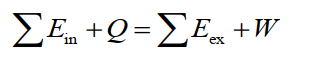
The ORC investigated in this paper is shown in Fig. 1. It consists of four different processes: process 1Æ2 (expansion through turbine), process 2Æ3 (heat rejection in condenser), process 3Æ4 (pressurized in pump), and process 4Æ1 (heat addition in evaporator). The analysis is based on the following assumptions: (1) the system is operating under steady-state condition, (2) no undesired pressure drop and heat loss occur in the system, (3) working fluid at the evaporator and condenser exits is saturated, and (4) isentropic efficiencies for the turbine and pump.With the assumptions above, the energy balance of each component based on the first law of thermodynamics is
| where Ein and Eex are the energy rate in and out; Q is the heat transfer rate; and W is the power output. The net power ouput of the ORC system (Wnet) is calculated by Eqs. (2), (3) and (4) |
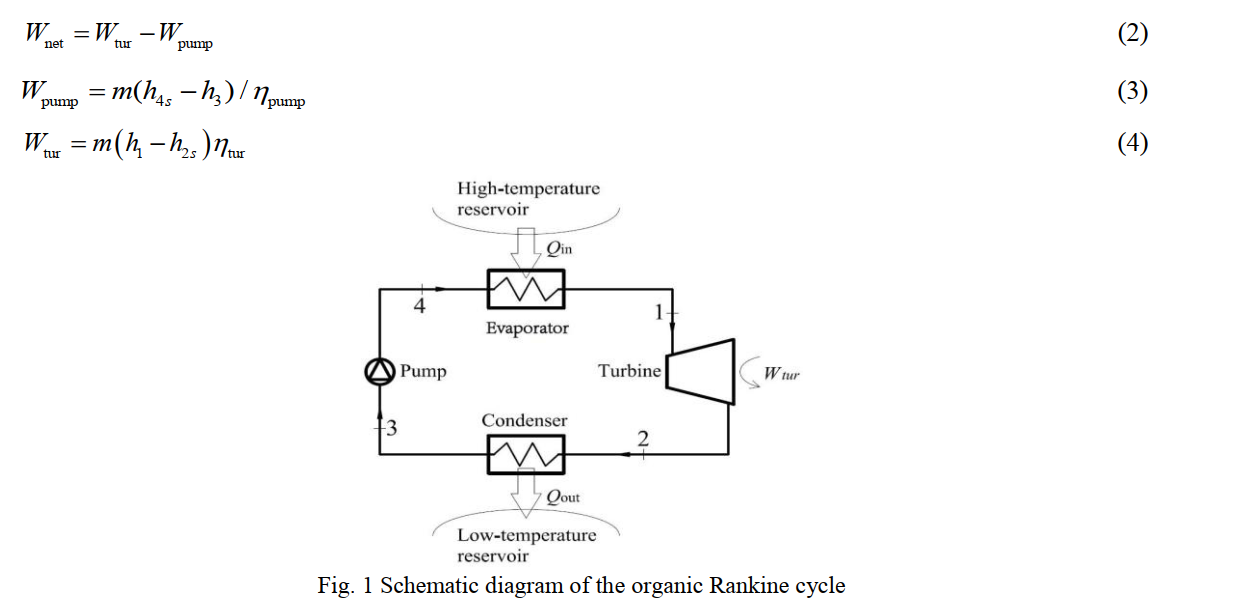
where W pump is the power consumed by the pump; h4s is the isentropic specific enthalpy of working fluid at the pump exit; ηpump is the pump isentropic efficiency; Wtur is the turbine power output; h2s is theisentropic specific enthalpy of working fluid at the turbine exit; ηtur is the turbine isentropic efficiency. The first and second law efficiencies of the ORC (ηI and ηII) are defined by Eqs. (5) and (6)
| KI net in W Q | (5) |
| KII net in 0 m W Q T T ª º ¬ ¼ 1- | (6) |

3. Results and discussion
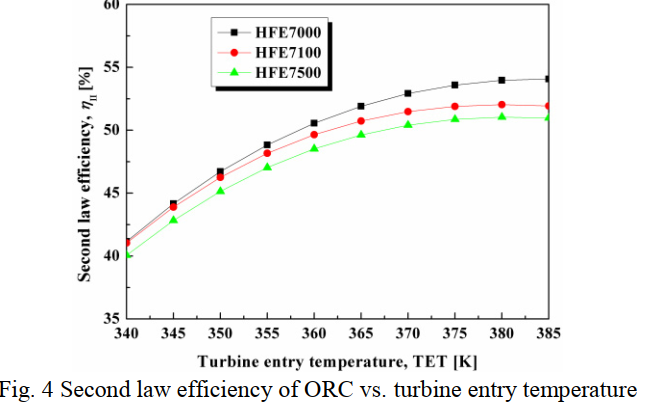
The purpose of this study is to parametrically analyze and compare the net power output, efficiency and turbine size factor of the ORCs using HFE7000, HFE7100 and HFE7500 as working fluids. A computer program in Engineering Equation Solver (EES) has been developed to simulate the thermodynamic performance of the tested working fluids under various turbine entry temperatures (TET). As previous researches such as [15-16] indicate that no superheating is preferred for dry fluids in the ORCs, the condition of the fluid at the turbine inlet is set to the state of saturated vapour in this study. In the following analysis, the input parameters are set as follows: the heat source mass flow rate is 1.0 kg/s; the heat source temperature is 150 oC; the condensing temperature is 28 oC; the turbine and pump isentropic efficiencies are 0.80 [17]; the pinch temperature differences in the evaporator and condenser are assumed to be 5 oC; the ambient temperature is 298 K. These input parameters keep constant for all cases. The analysis is provided graphically in Figs. 2-5.Fig. 2 shows the effect of the turbine entry temperature on the net power output of the ORC. It is found that with different working fluids, the influences of the TET on the net power output are similar. The net power outputs of HFE7000, HFE7100 and HFE7500 increase with the TET firstly but then decreased, and there exists optimum TET values that can maximize net power outputs. Among these three working fluids, HFE7000 has the lowest boiling temperature. Generally the working fluid of low boiling temperature produces large net power output. However, HFE7000 and HFE7100 produce almost the same net power output in the low TET, and this is because under the set conditions the mass flow rate of the working fluid is different. Actually, HFE7100 and HFE7500 obtain higher mass flow rates under the same TET.Fig. 3 presents the effect of TET on the first law efficiency of the ORC. It shows that the first law thermal efficiency increases monotonically with the TET. With the TET rising from 340 to 385 K, the first law efficiencies approximately increase from 7.76% to 12.58% for HFE7000, from 7.55% to 12.09% for HFE7100, and from 7.54% to 11.95% for HFE7500. HFE7000 obtains the highest thermal efficiency, followed by HFE7100, and HFE7500 which shows relatively poor performance.The variation of second law efficiency versus the TET is shown in Fig. 4. It can be seen that the second law efficiencies increase with the TET but the slope of the curves decreases. This is coordinate with the research done by Liu et al. [18]. In the present study, HFE7000 performs better than other two working fluids on the second law efficiency especially under higher TET. In Fig. 4, the second law efficiencies increase 12.91% for the HFE7000, 10.89% for the HFE7100 and 10.92% for the HFE7500.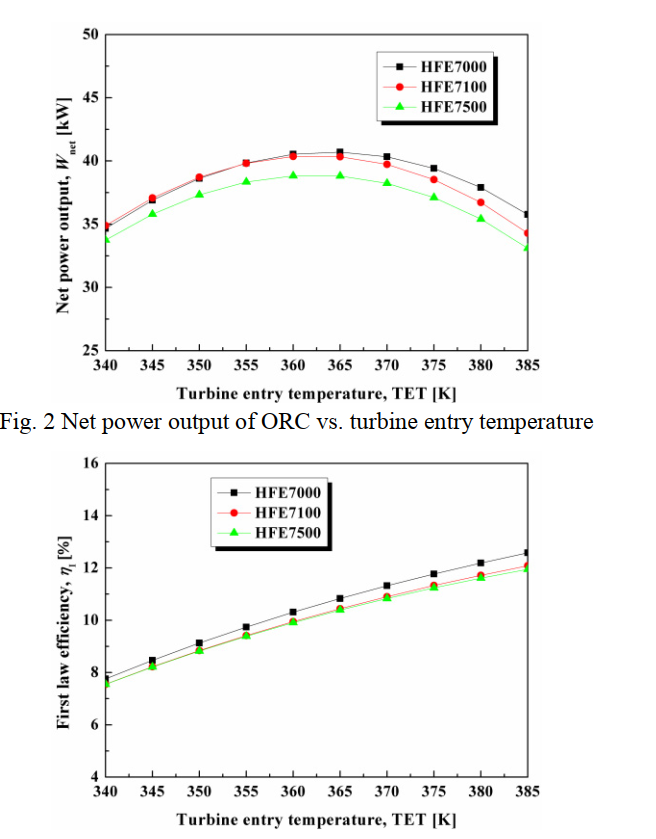
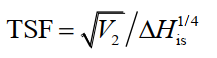
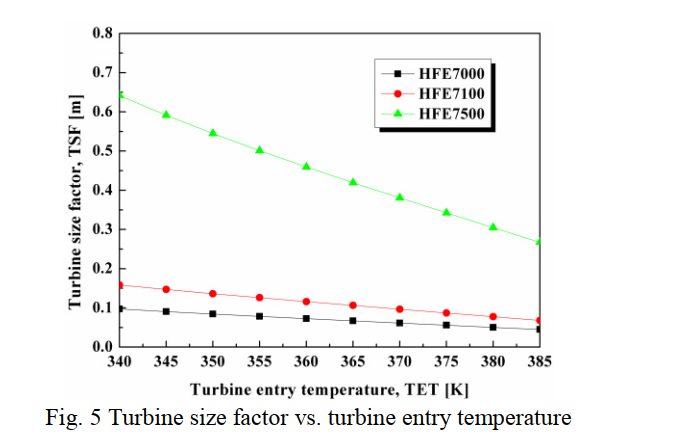
Fig. 5 illustrates the effects of the TET on the turbine size factor of the ORC. It is seen that the turbine size factor always decreases as the TET increases. For the conditions under consideration, small size factors are obtained for HFE7000 at high TETs. HFE7500 requires the largest size parameter due to the very low evaporation pressure. Overall, HFE7000 has the lowest turbine size parameter at all the TETs. For example, with the TET at 360 K, the turbine size factor for HFE7100 and HFE7500 are about 1.6 and 6.3 times that of HFE7000.
4. Concluding remarks
The ORCs using HFE7000, HFE7100 and HFE7500 as working fluids are parametrically analyzed and compared on the basis of the thermodynamic efficiencies, net power output and turbine size factor. Under constant external conditions, a computer program in EES has been developed to calculate the thermodynamic performance of the three working fluids under various turbine entry temperatures.Based on the present analysis, it is found that (1) with the turbine entry temperature increasing, for all working fluids investigated, the thermodynamic efficiencies of the ORC increase, the turbine size factors decrease, and the net power output has peak values; (2) among the studied working fluids, HFE7000 performs better on the thermodynamic efficiencies and net power output; and (3) the smallest turbine size factor is occurred in the case of HFE7000, followed by HFE7100, and HFE7500 takes the largest turbine size factor. Hence, in general, it is a good choice to use HFE7000 as working fluid in ORC to convert low-grade heat into power.
